
Getting Started with Every Day Counts Calendar Math: Grade 2
Step 1: (30 minutes)
If you are new to Every Day Counts, read the front matter (p. 5-9) in the Every Day Counts teacher’s guide and August/September (p. 16-17). This will help you get to know the EDC elements and how to set up for the start of school.
If you possess an older HMH EDC Kit in a yellow box, you may already have many of the items mentioned below. The suggested times are for teams creating new materials or replacements to display at the start of the year.
Step 2: (5 – ? minutes)
Examine your room set-up to find the best place to display Every Day Counts so that all students can see all the elements. A bulletin board is handy for pinning up the materials, but if such a board is not present or not in a good location for viewing, many teachers have been able to place the calendar and other elements on a wall, whiteboard, or chalkboard using tape or magnets. Some have even placed a science display board or sheet of foam core in the chalk tray to tape, or pin elements to using T pins. It is nice if you can gather the children up close to view the Calendar and other elements. The Counting Tape needn’t be in the same part of the room as the other elements on the board as long as everyone can see it.
EDC Counting Tape & Hundred Chart – Day of School
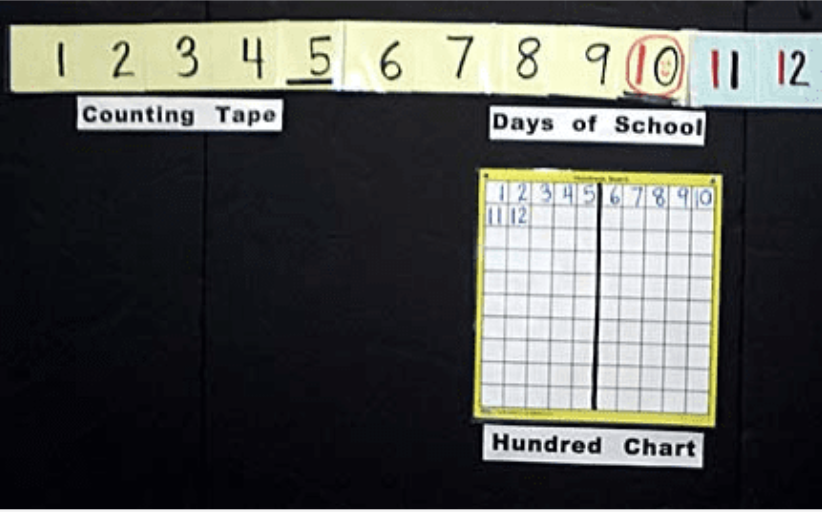
Step 3: (25 min. prep) Begin 1st day of school or catch up to present Day of School
See T Guide, p. 23-25 and click on Gr. 2 – EDC Photos & Question Cards at edconline.net
1. Unroll and put up at least 15 feet of a blank 3-inch wide adding machine tape or sentence strips.
2. Collect 8 sheets each of yellow and light blue 9” x 12” construction paper to cut into 3″ squares, or use pads of light blue and yellow 3-inch post-its. You will be attaching a square each day of school alternating the color every ten days. (See photo.)
3. Display a commercial blank Hundred Chart, or make one by enlarging Blank Hundred Chart (TR 24) from the back of the T. Guide to print a 10” x 10” grid on 11” x 17” paper. Trim and back with red 12” x 12” construction paper.
EDC Coin Counter – Day of School
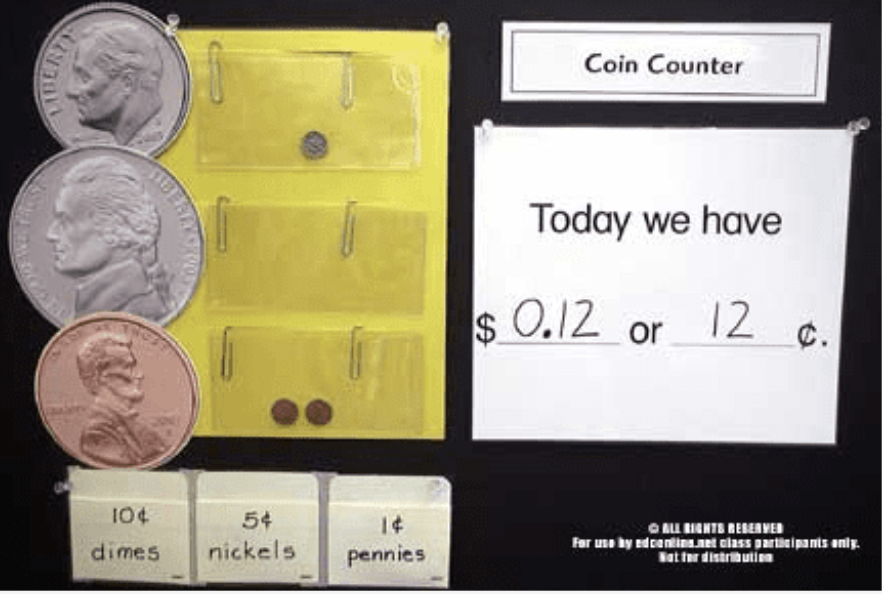
Step 4: (10 min. prep) Begin early in the school year to show Day of School in cents, trading pennies for nickels, and nickels for dimes, whenever possible.
See T. Guide, p. 25-26 and click on Gr. 2 – EDC Photos & Question Cards at edconline.net
1. Attach three small clear pockets or snack-size Ziplocs to the bulletin board, one each for pennies, nickels, and dimes. Make 1 copy of Coin Counter Record (TR 8) record and place it in a sheet protector next to the Coin Counter. (See photo.)
2. Display a matching large Demo Coin beside each pocket. A download to print Demo Coins is available at payhip.com/everydaycounts.
3. Place Coin Counter Record (TR8) into a sheet protector and place by Coin Counter. Use ONLY dry erase. If you choose to laminate, use transparency pen. Dry erase will stain laminate.
4. Place a coin supply of real coins (5 pennies, 2 nickels, 7 dimes) in re-sealable snack bag nearby.
EDC Calendar & Birthday Markers – Beginning of Sept or 1st Month of School
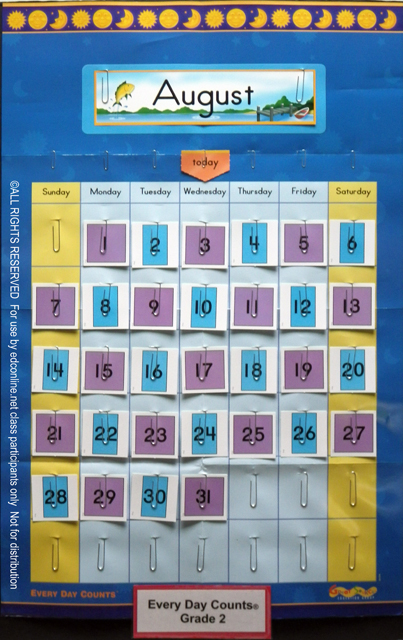
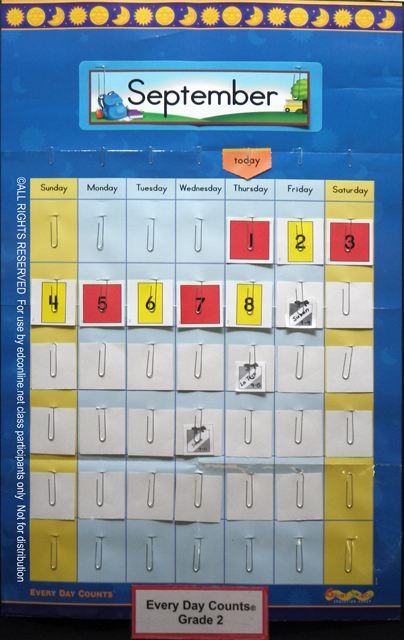
Step 5: (25 minutes prep) No lamination needed. Begin the 1st of September or catch it up to present day in September.
Note: If you begin school in August or are year round, you may choose to use the August pieces for your first month of school. August and September reveal the same basic pattern.
See T. Guide, p. 18-20 and click on Gr. 2 – EDC Photos & Question Cards at edconline.net
1. Prepare any school or office supply large cardstock wall calendar by creating slits at the top of each space using an Exacto knife or box cutter. Then slide a paper clip into each slit. (See photo.) Some teachers prefer to display a nylon classroom calendar with clear pockets. Models from Eamay and Arzog accommodate the size of the calendar pieces and are among the least expensive brands.
2. Pull out the three sheets of Calendar pieces for your first month of school, available both in print and as a download to print at payhip.com/everydatcounts. Display the pattern pieces on the Calendar from the 1st up to the present day of the month. Place the remaining pieces face down, so they can be turned over one day at a time.
3. Make 2 copies of Birthday Markers (TR 5) from the back of the T Guide. For children having birthdays during this first month, write each child’s name and birthday on a Birthday Marker (TR 5). Invite the children to place their markers on the Calendar.
EDC Computations and Connections: (+ and – 0, 1, 2 facts)
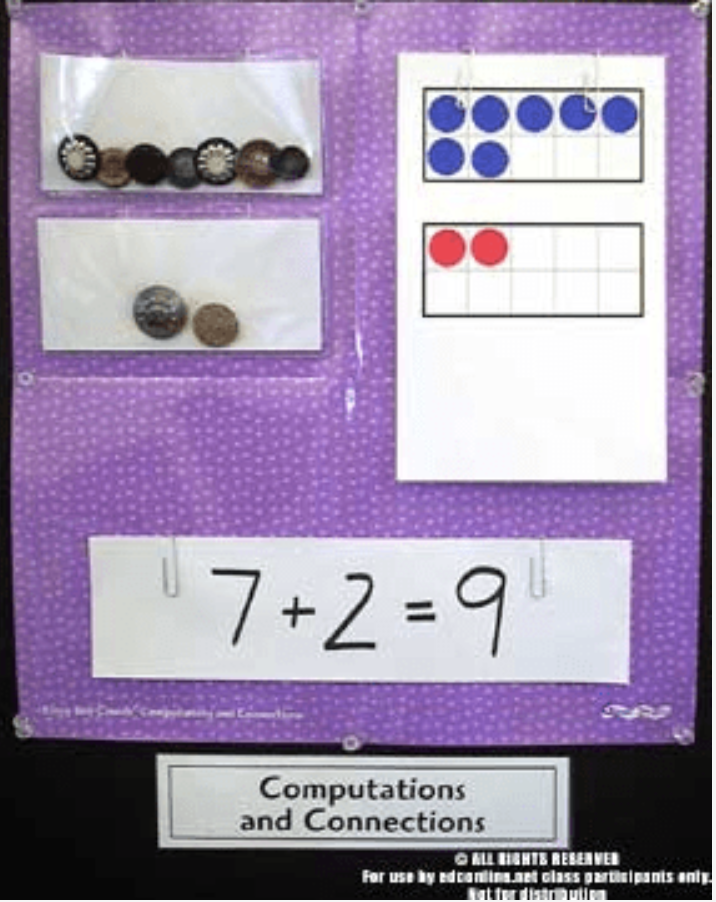
Step 6: Locate the Computations and Connections poster from the Every Day Counts Kit.
See T. Guide, p.20-22, and click on Gr. 2 – EDC Photos & Question Cards at edconline.net
1. Tape two sheets of 8 ½ x 11 cardstock together for a background. Create slits and insert paper clips to hold two small clear pockets or snack-size on the left side. (See photo.)
2. Make 10 copies of Double Ten Grids (TR 12) located in back of T. Guide. Attach some to the right side of mat. (See Photo.)
3. Cut 5 sheets of copy paper lengthwise and attach across the bottom for recording equations. (See photo.)
4. Place 10 buttons, pennies, or plastic counters in a container nearby along with red and blue felt marking pens for creating a +0,+1 +2 fact cards.
You are done!
This is everything you will need to begin sharing the September elements with your students. September requires the greatest preparation time. Next month you will continue to use these materials and add in a couple of new items. By November all the elements will be introduced reducing preparation time for the remaining months.
To see Question Starter Cards click on Gr. 2 – EDC Photos & Question Cards at edconline.net
The note cards you see accompanying each photo with starter questions can be printed as PDF files, cut apart, and mounted on 5×7 note cards for your easy reference during Every Day Counts discussions. During the month, please add to your cards questions of your own design or questions from your reading that you want to remember to try out. Some questions should aim at simply having students examine the data and describe what they see. Others questions should require students to engage in higher level thinking, requiring them to reason, analyze, make predictions, and form generalizations about concepts being explored each month.
Every Day Counts® is a registered trademark of Gillespie Kanter Group, LLC
To purchase teacher guides, calendar pieces, and other display items, visit: payhip.com/everydaycounts